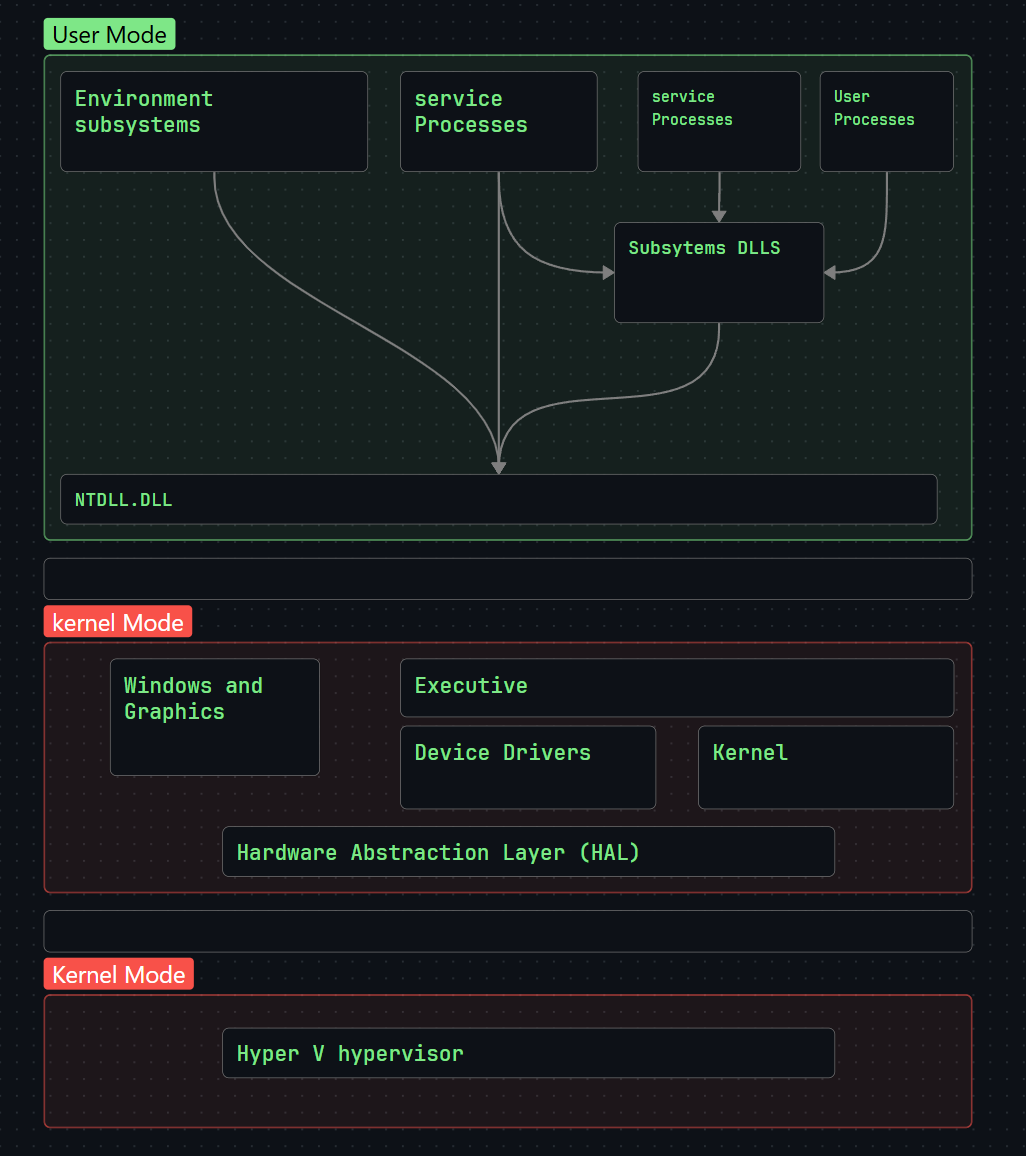
Basic User Mode Processes:
User Processes:
Processes which are started by the user.
Service Processes :
Services generally have the requirement that they run independently of user logons. These are generally started by the service control manager.
System Processes :
These are fixed, or hardwired, processes, such as the logon process and the Session Manager, that are not Windows services. That is, they are not started by the Service Control Manager.
Environment Processes :
Each subsystem runs as a server process (or set of processes) that can host applications for that environment
Note
The role of subsystem DLLs is to translate a documented function into the appropriate internal (and generally undocumented) native system service calls implemented mostly in
Ntdll.dll
Kernel Mode Processes:
Executive :
The Windows executive contains the base OS services, such as memory management, process, and thread management, security, I/O, networking, and inter-process communication.
The Windows Kernel :
This consists of low-level OS functions, such as thread scheduling, interrupt, and exception dispatching, and multiprocessor synchronization. It also provides a set of routines and basic objects that the rest of the executive uses to implement higher-level constructs.
Device Drivers :
This includes both hardware device drivers, which translate user I/O function calls into specific hardware device I/O requests, and non-hardware device drivers, such as file system and network drivers.
The Hardware Abstraction Layer (Hal) :
This is a layer of code that isolates the kernel, the device drivers, and the rest of the Windows executive from platform-specific hardware differences (such as differences between motherboards).
The Windowing and Graphics System :
This implements the graphical user interface (GUI) functions (better known as the Windows USER and GDI functions), such as dealing with windows, user interface controls, and drawing.
The Hypervisor Layer :
This is composed of a single component is the hypervisor itself. There are no drivers or other modules in this environment. That being said, the hypervisor is itself composed of multiple internal layers and services, such as its own memory manager, virtual processor scheduler, interrupt and timer management, synchronization routines, partitions (virtual machine instances) management and inter partition communication (IPC), and more.
The basic windows Architecture looks like this :
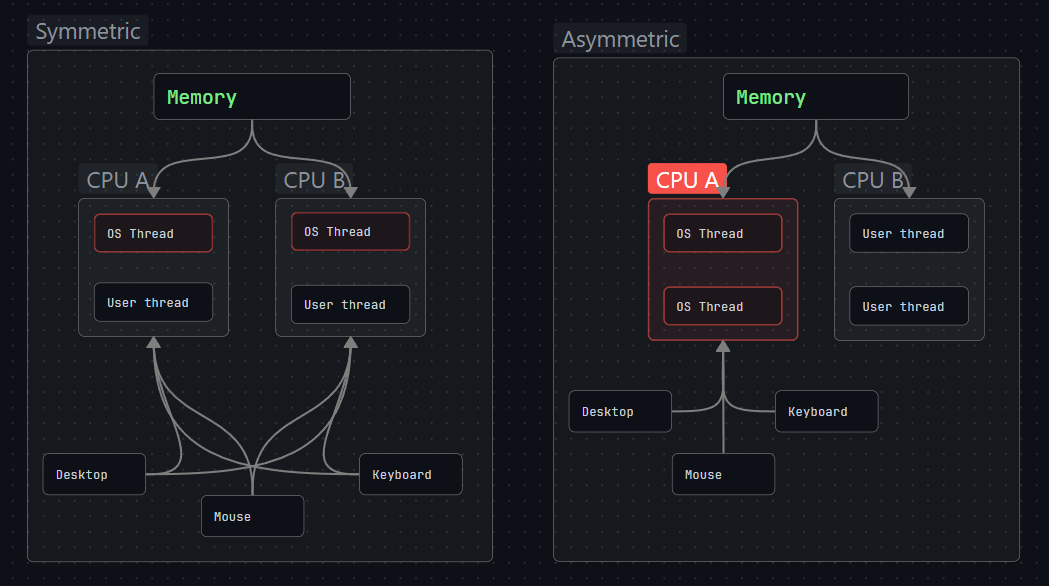
Windows is a symmetric multiprocessing operating system. Windows is a symmetric multiprocessing (SMP) OS. There is no master processor—the OS as well as user threads can be scheduled to run on any processor. Also, all the processors share just one memory space. This model contrasts with asymmetric multiprocessing (ASMP), in which the OS typically selects one processor to execute OS kernel code while other processors run only user code.